
|
METSATÖLL
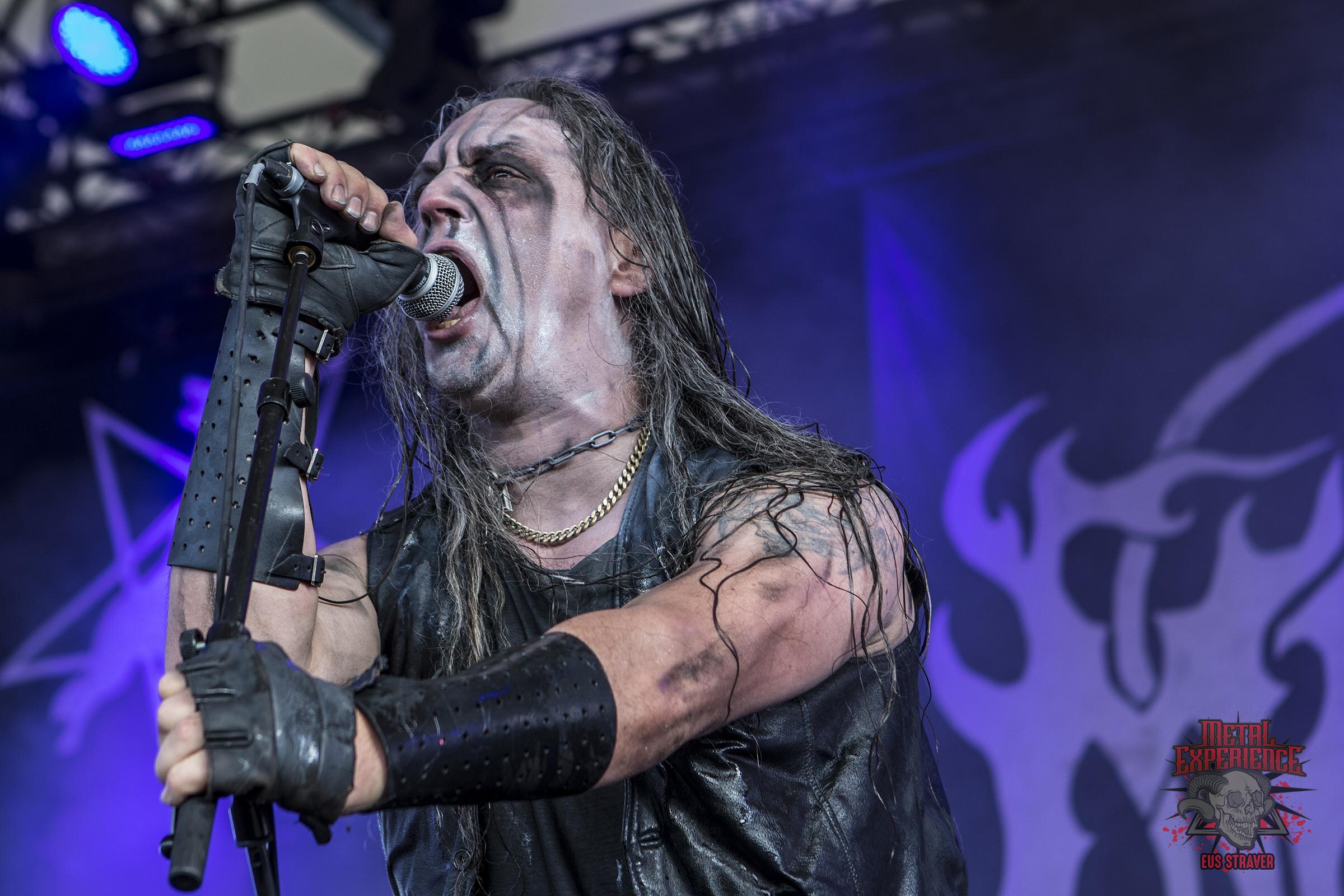
is an Estonian folk metal band. The name "Metsatöll" is an ancient
Estonian euphemism for wolf, which is reflected in the harshness of
their lyrics. Much of their material, featuring flutes and other
traditional instruments, is based on the wars for independence of the
13th and 14th centuries. The band started playing in 1998 as a
three-piece (Markus – vocals and guitar, Factor – drums, Andrus – bass),
playing epic heavy metal with subtle influences from ancient Estonian
folklore. Their debut album called ‘Terast Mis Hangund Me Hinge’ (Steel
Frozen In Our Souls) was released at that time.
In 2000, a good friend Varulven joined the band. Thus far he had
observed the activities of the band and had from time to time joined
them on stage. Varulven is a self-taught player of a number of ancient
Estonian folk instruments and they soon realised that metal and old
Estonian folk fit together perfectly. Since then, the music of Metsatöll
has intertwined more and more with old Estonian runo-singing and
traditional melodies. After several line-up changes, Metsatöll released
their second album, called ‘Hiiekoda’ (My Home, My Sacred Grove) in late
2004, which was critically acclaimed by both metal and non-metal fans
from all over Estonia. It is a heavy metal album strongly combined with
old Estonian traditional instruments. In 2005, Metsatöll released a
remake of their album ‘Terast Mis Hangund Me Hinge’ which they called
‘Terast Mis Hangunud Me Hinge 10218’ . The number stands for the world's
age according to Estonian chronology. On the remake the folk music
element is more prominent and the album has a much more professional
sound in general.

In 2009, Metsatöll signed with the Finnish record label Spinefarm
Records and they recently released their new album which is entitled "Äio".
In order to get to know the band a little better, we recently talked to
Markus (Vocals, Guitar), Raivo
(Bass, Vocals) and Lauri (Vocals, Guitar, Flutes, Torupill). Here
you can read what they had to say to the readers of Metal-Experience.com
First of all, how are you doing? Congratulations on your new album ‘Äio’,
of course we’d like to ask you a couple of questions about it!
Could you start this interview off with a little update of what’s been
happening since your previous release ‘Livakivi’?
Markus:
After the release of ‘Livakivi’ we toured Estonia and Finland for
a bit, followed by a few gigs elsewhere in Europe. We filmed a DVD
called ‘Kõva Kont’ and all of a sudden we found ourselves
negotiating with Spinefarm. And about half a year after the contract was
signed, inspiration for a new album arrived…
Raivo:
And in order to get rid of the inspiration, we started writing new
songs. But the more we worked on the news songs, the weightier the
inspiration on our shoulders became. We could have written several
albums in one go, but luckily we ran out of time and had to embark on
the European tour.
How did you launch into writing material for ‘Äio’ and how much time did
you spend on the songs?
Markus:
It happened in the spring of last year, in March, when new material kept
accumulating and we realized that a new album was inevitable, even
though we knew our European tour had already been settled. At first we
did some demos in our rehearsal room, but early in summer we travelled
to the other end of the country, to a solitary farmstead. I guess
composing the songs took about four months. After that, we began
recording them.
Raivo: Some songs were born in a matter of minutes, some failed
to mature enough to end up on the album. They will have to wait for
their time.
Which approach did you choose to create this album, did you go for a
more raw exposition.. Or something more reminiscent of your previous
other works, or something all together different?
Markus:
I think that Äio is recognizably Metsatöll, but we added
something more intellectual as well as raw speed to our new songs. I
think we took a step forward compared to our previous albums.
Raivo: There was no prior conception, the only condition was that
the album must not copy our previous releases. The songs came out the
way they did, the way we are right now.
Lauri:
I think that with Metsatöll, the approach will choose the songwriter,
rather than the songwriter choosing the approach. Everything is born
spontaneously and in accordance with our low brows.
Did ideas come easily so that you just had to write them down or was it
more of a careful composing thing?
Markus:
The reason for recording the new album was precisely that the
inspiration was so good. Nothing had to be dragged out of us forcefully.
Writing this album was really quite easy.
Raivo: There were no big birthing pains, just the happiness for
getting a new litter of songs. And then a lot of work elaborating the
songs.

What comes first, lyrics or melodies?
Markus:
This is different each time, but specifically with ‘Äio’ it was
melodies first, and only then the lyrics. Or to be more precise, first
we had the riffs (the basic tracks), then melodies and then lyrics.
Raivo: Indeed, for this album the emotions coming from the basic
tracks told us what the song would come to be about.
Lauri: Lyrics and melodies. But, of course, a metal song consists
not only of lyrics and melodies, but lyrics, melodies and the damn heavy
drumming. So, it doesn’t matter what comes first, the lyrics or
melodies, the drumming finally smothers it all anyway.
What were the goals you had in mind when you started to record ‘Äio’,
any elements you definitely wanted to include on the album?
Markus:
The goal was to turn the inspiration into good songs and to make sure no
song would repeat itself, and then to definitely use a real male choir;
previously, we sung the choir parts ourselves, but this never turned out
like the real thing. There is also more room for different traditional
instruments. We also wanted the best possible production values for our
music, to make sure it sounded properly powerful.
Raivo: The choir bits were a separate goal. We have co-operated
with the National Male Choir before and it would be a great loss to
leave it just with that one project, since a male choir fits perfectly
with Metsatöll’s music.
Was it a conscious decision to do it this way?
Markus:
We were hoping that Äio would turn out the way it did, and we are
more than satisfied with the results. Karmila is God!
How can we imagine you work on new songs, what's the typical writing
process like for Metsatöll? For example, is it a group process or did
some people write more songs than others?
Markus:
It goes both ways. Mostly, each member of Metsatöll will generate their
ideas somewhere else than together in the rehearsal room. In the
rehearsal room, we will start to try and fit the different ideas
together. It has happened that one member has written an entire song
from start to finish, but this is very rare.
Raivo: For me, various different riffs were born in the rehearsal
room as well. The studio equipment in the rehearsal room allowed us to
make proper recordings of the songs before heading off to the studio, so
that we could discover the merits and faults of our brainchildren by
listening to the rehearsal recordings, and in this way it was simple to
make things better and get rid of the unnecessary parts. The end result
was down to group effort, everybody added something and if most people
thought that some idea is crap or we had already heard it from
somewhere, its life was ended by the Delete button.
Lauri: It really depends on the song, every song embodies its own
and unique creative process: there are songs written by one person,
songs spiced up with additional details from others, and then there are
true mathematical constructions all banged up together, with which
nobody remembers who came up with what.
What is the utmost important ingredient for a song according to you?
Markus:
I like it when there are interesting bass guitar riffs; an interesting
and different use of the bass guitar adds melody and natural power to
our music.
Raivo: The song must have emotion.
Lauri: Different components work with different music. If we take
a wider perspective, not just with this album and band, the most
important component of a song is its message, and that it will reach the
target audience. Music is a conscious or subconscious means of
communication and it is important to make sure that what you communicate
with the song would be well within the competence of you as a
songwriter, you must know what you are doing and are about to do, what
you want to say. If you do not know, or cannot take responsibility for
the information you are shooting out of your mouth and heart, your song
is no more valuable than the crowing of cocks or the shrieking of pigs.
Then again, the shrieking of pigs does have its own aesthetic value, at
least then you know that soon you will be having some good sausages.
Could you please describe the implications of the title ‘Äio’, what does
it stand for and is there a special meaning behind it?
Markus:
‘Äio’ is the essence of sleep. Sleep is the brother of death. ‘Äio’
gives people sleep to rest from daily troubles, lets the soul free and
allows it to soar. Sleep makes the aching body and soul strong again.
Lauri: ‘Äio’, which appeared in the older South Estonian
literary language as “Äiu”, in more recent times and even today appears
in the choruses of lullabies: “Äiu-äiu, kussu-kussu” (English match for
“kussu” is “hush”, in South Estonian “tšuu-tšuu” – everywhere it sounds
the same). Putting the child asleep was a magical activity and lullabies
were kinds of magical spells that work quite well even today – the child
does fall asleep. Thus was the child hushed to sleep. ‘Äiu’ or ‘Äio’ was
the essence of sleep that came upon people and took them into its power.
‘Äio’, similar to other essences or powers (these are not gods as they
appear in the world-view of a western person, even the word “jumal”
which corresponds to “god” means in the Estonian language a power or
essence, not an old geezer sitting on a cloud), such as Taara
(subsequently the Scandinavian male god Thor), or the earth-mother, is a
female essence. Not a male, as it is with the concept of God in the
Christian tradition. In Finland, the word for mother is “Äiti” – the one
who hushes. Before Äiu there was definitely also “Uni” (sleep) who was
called upon – this is also readily apparent in old lullabies. Meanings
change in time, as do beliefs.
In olden times, the following was sung to children: “Äiu-äiu towards
death, grow towards cold grave, move towards a sandy hole” – sleep, too,
was like a small death. Remember that small children are afraid of going
to sleep, because they do not know, once they fall asleep, whether they
will ever see the next morning, the sun and the hushing mother again.
This is where the “brother of death” comes from. Or was it the sister –
I can no longer remember.
And thus like children we all go to sleep each night, but we have become
accustomed to waking up every morning, and that each day the sun will
rise again and that every day our life-keeper will be there, be it the
hushing mother, the mother of our own children, or the earth-mother. But
one day death will take sleep’s place.
Who was responsible for the lyrics on this album and where do you get
your inspiration from? Are there any stories behind the lyrics?
Markus:
Quite honestly, it was Kuriraivo who gave his best with the lyrics. The
topics that we sing about are timeless, they are legends and fantasy.
Raivo: Like the music, Metsatöll’s message has become ever more
grown-up as the years go by. With our next album our goal is to reach
yet another level and then Metsatöll’s lyrics will turn into the senile
grumbling of old geezers.
Lauri: I’m always in favor of one person writing all of the
lyrics of one song, because world-views are different and ways of
expressing as well. It is the same way with this album, too – every song
is its own unique story.
How did the recording process proceed this time, did you work
differently than on previous albums? How much time did you spend in the
studio?
Markus:
Recording this album was truly unique. We recorded in three different
studios. The drums were recorded in Finnvox studios in Finland. Guitars,
bass and vocals were recorded in Tallinn, and the traditional
instruments and some vocals were recorded in Tartu, in South Estonia.
Mixing was again done in Finland, once we got back from the European
tour. Recording took about three months.
Raivo: We were very precise even about the smallest of details,
while at the same time trying to maintain a natural feel. I believe that
we succeeded in this.
Lauri:
What I liked was recording my instruments, we chose the closest possible
location for me – I only had to drive 86 kilometers from home, while the
capital is over 300 km away. In the Tartu studio I could take my time
and, having nothing but alcohol-free drinks, I could immediately record
whatever whacky idea came to mind. Most of the time was nevertheless
spent not on playing and recording, but on unpacking and tuning the
instruments. I guess I overdid it a little bit. To console the listener,
however, I can admit that not all of the instruments were used on the
album!
Do you have any favourites on the album?
Markus:
Just as with previous albums, I like all of the songs on ‘Äio’.
We will not put a song that we don’t like on our album.
Raivo: It depends on the moment, but there are no children on
this album that do not receive our fatherly love.
Lauri: My favorite is “Come Now My Kindred” mainly due to
Kuriraivo’s lyrics, it is a damn pity that non-Estonians will not get
the full pleasure out of it, since the English language is simply unable
to express everything that a proper Estonian sauna does to a man!
Have you received any feedback on the album yet?
Markus:
It’s too early to tell! I guess that perhaps in a month or so a few
reviews will have been published and then I can give a better answer.
Raivo: My brother said that it’s a pretty good album.

Are third party opinions (press, fans, etc.) on your music important to
you? Or are your music and band the only things that matter?
Markus:
This again goes both ways, in the sense that it is very good if people
care about what we do, but we are all down to earth and understand that
you cannot appeal to everyone. We make our music the way we like and
it’s the best this way. Because if you allow yourself to be influenced
by the opinion of others, you may end up doing nothing at all.
Raivo: Surprisingly, we have not had to take others into account,
because if we like it ourselves, there’s a good chance there is somebody
somewhere who will buy the album, and with us, there are in fact several
of these somebodies. We haven’t changed ourselves according to other
people’s pointers and I think you can hear that on the album.
Overall, are you pleased with the outcome of the songs or would you have
liked to have changed anything in retrospective? Which element on the CD
are you most proud of?
Markus:
I like the album cover and the back picture.
Raivo: The album is quite long, but no song can be excluded,
everything is the way it has to be.
Can you tell us a little about yourself and the kinds of things that
motivate you in your writing, your poetry, and your lyrics?
Markus:
I am mainly motivated to write by the nature and life around me. I can’t
really answer this question because inspiration cannot be commanded.
Raivo: I want to write about things that have substance. It was
not hard to find motivation for ‘Äio’, all sorts of different
topics keep circling around.
Lauri: To create motivation for anything, there’s nature all
around. It is great that in Estonian, “loodus”, the word for nature,
means “in the creation”.
Which song is your favourite one to play live? Which song do you find is
the most challenging one to play live?
Markus:
I have several that I like to play the most. It is more difficult to
play faster songs at the end of gigs, because the heat and sweat on
stage do their work, but damn how I love it.
Raivo: It depends on where you play. If you get a good contact
with the audience, then the gig will be good. Naturally enough, it is
more difficult to play the more complex songs, but it is precisely this
that is exciting.
Could you respond to the following terms in just one word or sentence:
Lauri:
I am certain the answers would be different if the concepts were in
Estonian or in Dutch!
Metal :
Markus: Music
Raivo: Ugly guys
Lauri:
Anvil
Underground :
Markus: Spirit
Raivo: Closed circle
Lauri:
Mole
Internet :
Markus: Electricity
Raivo: Efukt
Lauri:
Loss of time
Religion :
Markus:
Poison
Raivo: Control
Lauri:
Cicero
Politics :
Markus: Chess
Raivo: Power struggle
Lauri:
Tactics
The Netherlands :
Markus:
PESTILENCE!!!!
Raivo: Bicycle
Lauri:
Hailander
Estonia :
Markus: Home
Raivo: Sweet home
Lauri:
Coin with two sides
With several albums under your belt, how far has Metsatöll surpassed
your original dreams and what would you say is the most rewarding part
of being in the band?
Markus:
Fifteen years ago I couldn’t even dream of recording albums and going on
tours. At the end of the 90s, metal in Estonia was dead as a doornail. I
assumed that I would stay in Estonia, play only in small clubs and make
albums when we would get the money for it, and burn our own CD-s. I’m
happy that we have made the choice in favor of making more music, that
we pulled ourselves together and kept pushing forward. Life has been
interesting, and there’s no point in denying that it is always great to
play live. And the emotion you get from playing in a band is not
measurable in money.
Raivo: After every year with Metsatöll, I’ve looked back in
surprise and thought, what a successful year, does it get any better
than this? And then the next year will be even better, and so on.

What were the highlights and low points throughout your career?
Markus :
1999 24.02: the decision to create Metsatöll.
2002 Video for Hundiloomine (The Creation of the Wolf)
2004 Hiiekoda
2008 Contract with Spinefarm
2009 European tour with Ensiferum.
Lauri:
Were these the highlights or the low points? :)
What is your opinion on the metal scene these days? What do you think
about the overload of bands at the moment and is there anything missing
in the scene?
Markus:
I like it that there is a lot of metal. Metal music has widened its
borders and we’ll see where particular genres develop in the next few
years. I don’t think there’s anything missing from the metal scene, I’m
more interested in seeing when the development will stop and what sorts
of bands will remain. I wouldn’t worry about there being too many bands,
because for every new band to appear, an old one will disappear… Where
to? I cannot tell.
Raivo:
I don’t really have the time to keep up with everything, I usually hear
the bands that have somehow gotten the upper hand in the competition and
thus are high quality. There is a lot of repetition though – I wish
bands were more original.
Lauri: Are there too many metal bands? I’m not up to date, either
– I can’t even remember when I last listened to a new metal album from
beginning to end – perhaps a year ago? Jokes aside, I think the problem
is not the number of bands in any given genre, but rather the endless
possibilities for using means of communication, the staggeringly easy
access to recording equipment and the stupendously fast spread of
information. I do believe that there is the same number of good
musicians across centuries.
What can we expect from Metsatöll in the near future, any touring plans?
Markus:
Currently we have a couple festivals coming up, no talk of tours as of
yet.
Raivo: We’ll just have to see what kinds of doors does ‘Äio’
open up for us, there will definitely be a lot of gigs all over.
Lauri: For tomorrow I’m planning a small tour of my home forest –
I don’t yet have sufficient firewood to last me through the year after.
Where do you see the band going within the next couple of years and
where do you see the band’s musical direction going for the next album?
Markus:
I cannot say what will become of us and it is too early to discuss the
next album, because ‘Äio’ is still so fresh.
Raivo: The musical direction of the next album will become
apparent during the next few years, when new ideas and thoughts begin to
sprout; we ourselves are constantly changing as well.
A last statement?
Markus:
See you on the battlefield!!!!
Raivo:
See you at coffee shops!!!
Lauri:
Raisk!
Best regards,
Eugene Straver

Members:
Markus Teeäär – Vocals, Guitar
Lauri Õunapuu – Vocals, Guitar, Flutes, Torupill (Estonian bagpipes) &
other traditional instruments
Kuri Raivo – Bass, Vocals
Atso – Drums, Vocals
Former members:
Silver Rattasepp – Drums
Andrus Tins – Bass
Albums:
(1998) - Terast Mis Hangund Me Hinge
(2004) - Hiiekoda
(2005) - Terast Mis Hangund Me Hinge 10218
(2007) - Curse Upon Iron (Live album)
(2008) - Iivakivi
(2010) - Äio
EP’s:
(2006) - Sutekskäija |